

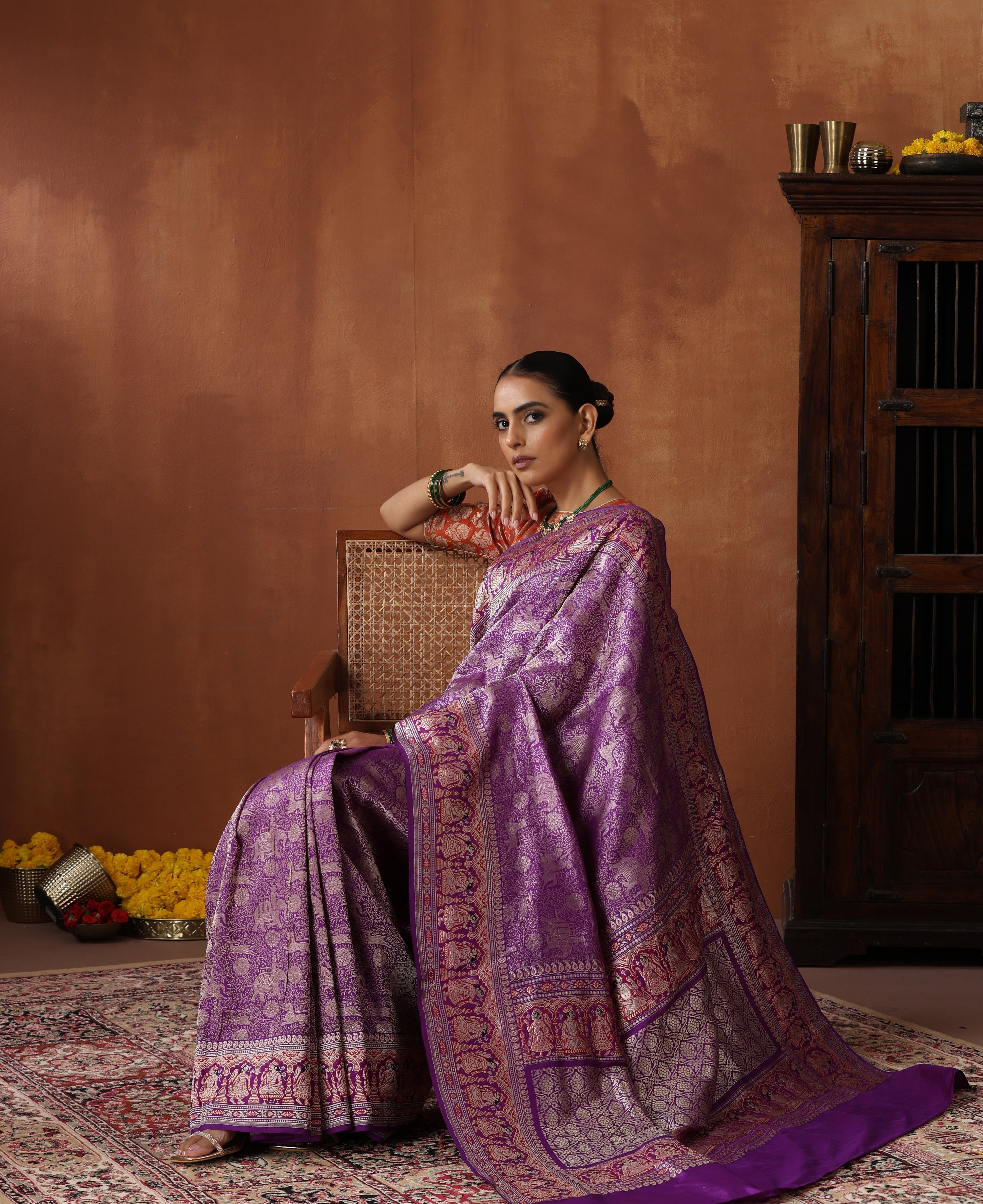
When you run your fingers across a Banarasi saree, what you're really touching is silk — nature's most magical fibre. Silk is the very soul of Banaras weaving. Without it, the artistry of brocade, the shimmer of zari, and the heritage of centuries would not exist.
How Silk is Born
Silk begins its journey in the humble cocoon of the silkworm. Fed on mulberry leaves, the silkworm spins a protective case made from its own saliva. This saliva hardens into a single continuous thread, so fine yet so strong that it can stretch for hundreds of metres. When collected and processed, these threads are spun into yarns that form the base of a Banarasi saree.
✨ Fun fact: It takes nearly 2,500–3,000 cocoons to produce the silk required for a single pure Banarasi saree.
Cultivated vs Wild Silk
Silk can be classified into two types: cultivated silk and wild silk.
Cultivated silk (from mulberry-fed silkworms) is smooth, lustrous, and uniform.
Wild silk comes from silkworms feeding on forest leaves. Popular varieties include Tussar, Moonga and Ari, each lending Banarasi fabrics a raw, organic beauty.
✨ Fun fact: Not all Banarasi silk is glossy. Sheer organza Banarasis are woven from fine, ungummed raw silk that keeps its natural matte crispness — a translucent cloth so light it is sometimes called “silk mist.”
Why Banaras Chose Silk
The weavers of Banaras didn't settle for cotton or wool when creating their masterpieces — they chose silk because of its brilliance. Silk has a natural sheen that makes zari sparkle brighter, colours appear more vivid, and motifs look alive. This is why a red Banarasi saree looks deeper and more radiant than a red cotton one.
✨ Fun fact: In ancient India, silk was considered so auspicious that brides were forbidden to wear anything else for their wedding rituals.
Silk as Heritage
From the Mughal era to modern-day Bollywood, silk has been central to Banarasi weaving. The Mughal emperors encouraged the art of silk brocades, introducing Persian-inspired motifs that remain popular even today. Over time, Banarasi silk sarees became a part of bridal trousseaux across India and were carried by women migrating to every corner of the world — from London to Los Angeles.
Silk Today
Even today, Banarasi silk remains unparalleled. While powerlooms and synthetic imitations exist, genuine silk continues to be the choice of women who value authenticity, heritage, and timeless luxury. Owning a silk Banarasi saree is not just about fashion; it is about carrying forward a legacy of artistry that has endured for centuries.
✨ Fun fact: Ancient Chinese traders called silk “the fibre of emperors.” In India, it is still referred to as “pavitra vastra” — the sacred fabric.
Closing Thought
The story of Banarasi sarees begins and ends with silk. It is silk that gives them their unmatched glow, silk that carries the zari like light on water, and silk that makes them worthy of being passed down as heirlooms. Every Banarasi saree is not just a drape — it's a celebration of the silkworm's gift and the weaver's genius.
Frequently Asked Questions About Silk
How is silk made?
Silk begins in the cocoon of a silkworm. Fed on mulberry leaves, the silkworm spins a continuous thread from its saliva. This thread is reeled, twisted into yarn, and woven into fabric. It takes nearly 2,500–3,000 cocoons to make a single pure Banarasi saree.
What is the difference between cultivated silk and wild silk?
Cultivated silk (from mulberry-fed silkworms) is smooth, uniform and lustrous. Wild silk — like Tussar and Moonga — comes from silkworms feeding on forest leaves. It is coarser, naturally golden or brown, and has a raw, organic character that many women love.
Why is silk used in Banarasi sarees and not cotton?
Silk has a natural triangular prism structure that refracts light — making colours appear deeper and zari sparkle brighter. A red Banarasi silk saree looks richer and more radiant than the same design in cotton. This is why Banaras chose silk centuries ago and never looked back.
Is a pure silk Banarasi saree good for all seasons?
Pure silk is naturally temperature-regulating — it keeps you cool in summer and warm in winter. However, heavy katan silk sarees with dense zari work can feel warm. For summer, lighter silks like georgette, kora organza or tissue are better choices.
How do I care for a pure silk saree?
Dry clean only for heavy katan silk. Store folded in a muslin cloth — never plastic. Refold along different lines every 6 months to prevent permanent creases. Keep camphor or neem leaves nearby to protect from insects. Avoid direct sunlight which can fade the colour.


