

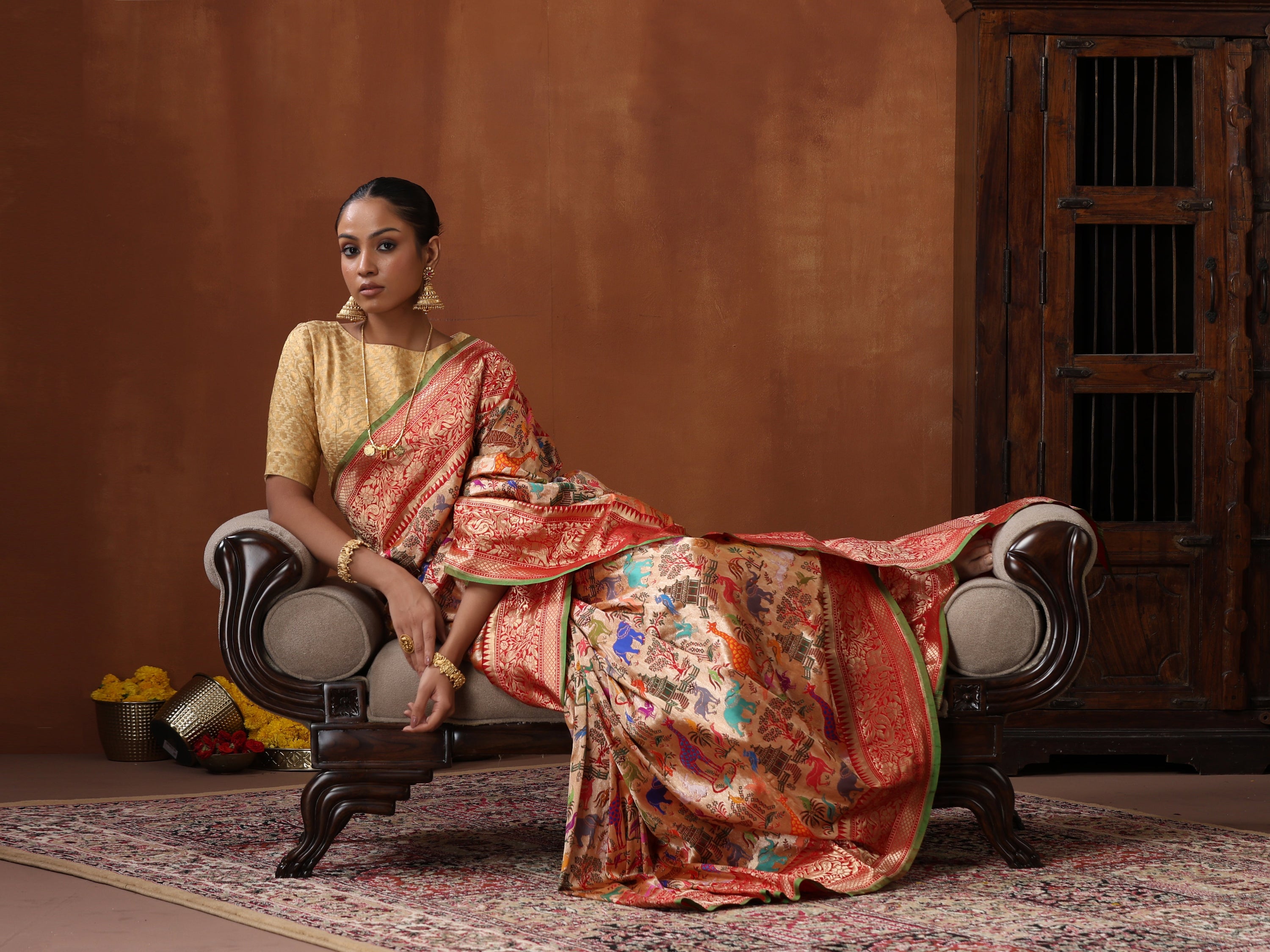
Among all the fabrics of Banaras, Katan silk reigns supreme. Known as the purest form of Banarasi weaving, Katan is smooth, lustrous, and incredibly strong — making it the perfect canvas for the city's most intricate brocades. If Banarasi sarees are a crown, Katan is their most dazzling jewel.
What is Katan Silk?
Katan is created by twisting two silk filaments together, producing a yarn that is both fine and durable. This simple technique gives the fabric a unique combination of softness and strength. The result is a saree that feels luxurious on the skin yet holds its shape, allowing for bold zari motifs and dense brocade patterns.
✨ Fun fact: A single Katan Banarasi saree can take anywhere between 15 to 30 days to weave, depending on the design's complexity. For heavy bridal weaves, the process may stretch to months.
A Legacy of Royalty
Historically, Katan silk was the choice of royalty. Mughal queens draped themselves in rich Katan Banarasis adorned with Persian-inspired motifs — florals, vines, and jali patterns. These sarees were treasured as heirlooms, often passed down from mother to daughter, carrying with them stories of lineage and love.
Why Brides Love Katan
Even today, the Katan Banarasi saree is a bridal staple. Its strong weave allows for intricate zari work in gold and silver, creating sarees that dazzle under wedding lights. The luxurious sheen of Katan makes colours like crimson, emerald, royal blue, and maroon appear deeper and more vibrant.
✨ Fun fact: Mughal chronicles mention that a Banarasi brocade woven in Katan was so precious, it was often used as currency in trade exchanges.
Modern Interpretations of Katan
While Katan is rooted in heritage, today's designers are giving it a contemporary spin. Pastel shades with minimal motifs, lightweight zari borders, and fusion blouse designs are making Katan popular among younger women who want elegance without excess.
Why Katan is Timeless
What makes Katan unique is its ability to evolve while holding on to its core identity. From Mughal courts to modern weddings in New York or Singapore, Katan has remained a fabric of choice for women who appreciate luxury and heritage.
✨ Fun fact: Some families in Varanasi still treasure 200-year-old Katan sarees, their zari intact, their silk glowing softly — proof of the fabric's enduring strength.
Closing Thought
To own a Katan Banarasi saree is to own a piece of living history. It is more than just silk — it is a story of patience, artistry, and timeless elegance. Whether draped by a bride on her wedding day or styled by a modern woman for a gala night, Katan continues to embody the heart of Banaras weaving: luxurious, eternal, and utterly captivating.
Explore our handwoven Katan silk Banarasi sarees — each one woven in pure katan, as the tradition demands.
Frequently Asked Questions About Katan Silk
What is katan silk?
Katan silk is made by twisting two pure silk filaments together, creating a yarn that is both fine and durable. This gives the fabric its characteristic smooth, tight weave and allows it to hold dense zari motifs without distorting. It is the purest and most prized silk used in Banarasi weaving.
How long does it take to weave a katan silk saree?
Depending on the design's complexity, a katan Banarasi saree takes between 15 to 30 days to weave on a handloom. Heavy bridal weaves with intricate shikargah or jangla patterns can take up to 3 months.
Is katan silk good for weddings?
Katan is the traditional bridal silk of Banaras. Its strong weave holds intricate gold and silver zari beautifully, colours appear deep and vibrant, and the saree drapes with a natural weight and structure. Most Indian brides across the country and diaspora choose katan for their wedding day.
How do I know if a saree is pure katan silk?
Rub a small section between your fingers — pure katan generates a slight warmth and has a crisp, smooth feel. The weave is tight and uniform. A genuine katan saree also has a characteristic rustle when draped. If in doubt, ask for a burn test on a loose thread — pure silk burns slowly, smells like burning hair, and leaves a crushable ash.
Does katan silk get better with age?
Yes — pure katan silk actually becomes softer and more lustrous with age and gentle wear. Some families in Varanasi treasure 200-year-old katan sarees with their zari still intact. Stored correctly in muslin cloth away from moisture, a katan saree is truly a lifetime investment.


